
Designing the STEM on the Green Game Board
Creating the “Wow” Factor
My goal for STEM on the Green was to create an experience that felt motivating, exciting, and encouraging for students. I knew I wanted the activities to have a “wow” factor, something that would make kids curious, get them involved, and allow them to experience what it really feels like to be engaged in a hands-on STEM activity.
As I searched online for activities and games, I realized I could not find anything that truly combined golf and STEM in the way I imagined.
So I decided to create one myself.
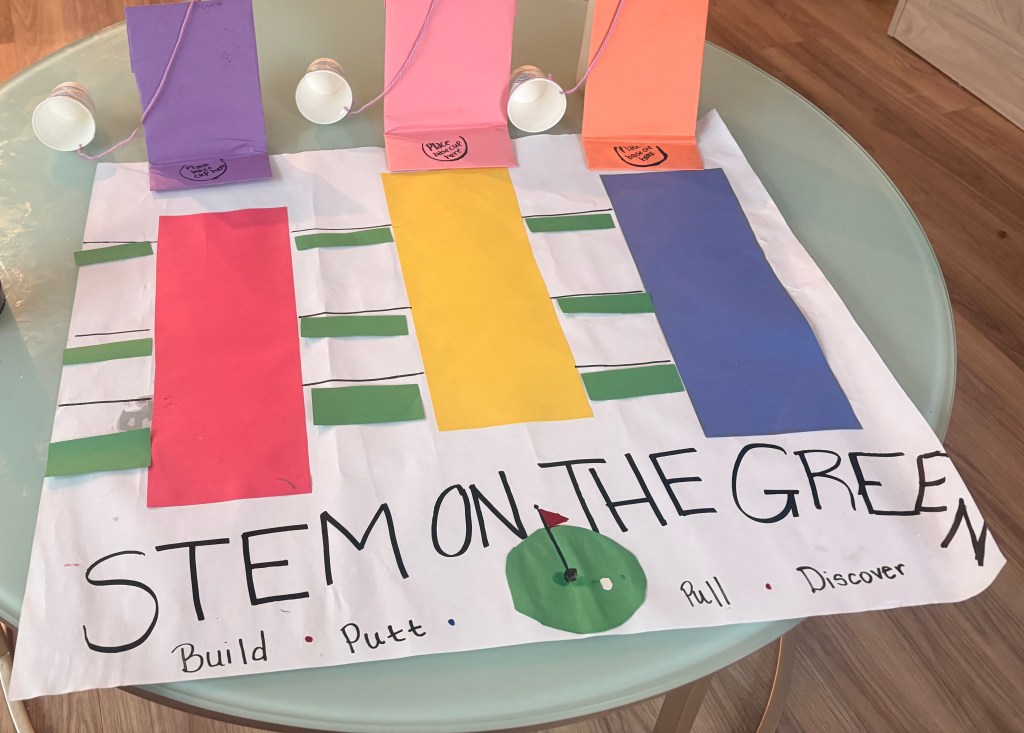
Starting With a Simple Prototype
My first version of the game was designed using a long sheet of paper, string, cups, and a lot of imagination.
Rather than starting with a finished product, I focused first on how I wanted the game to work and what I wanted the students to learn from it. I knew I wanted to incorporate a simple machine into the experience.
My original idea was to create a pulley system, but as I worked through the concept, I realized a pulley might make the activity more complicated than necessary for some of the younger students.
That led me to a simpler idea: a lever.
Connecting Golf to STEM
The game was designed to help students explore concepts such as force, speed, accuracy, and power while also practicing problem-solving and strategy.
In golf, players constantly make decisions about how much force to use, where to aim, and how to adjust their approach to successfully reach a target. I wanted students to experience those same ideas through the game.
Instead of simply trying to get a ball into a cup, students had to think about questions such as:
- How much force should I use?
- Where should I aim?
- What happens if I hit the ball too hard or too softly?
- How can I adjust my strategy on my next attempt?
The goal was to make the STEM concepts feel like part of the game rather than something students were simply being taught.
Bringing the Experiment to Life
I also wanted the activity to have a visible reaction when students successfully reached their target.
I knew that combining baking soda and vinegar would create an exciting chemical reaction, so I began thinking about how I could incorporate that reaction into the design of the board.
I strategically positioned cups throughout the game so that one could serve as the target. Once the golf ball successfully reached the target cup, the student could activate the lever mechanism.
Pulling the lever would then trigger the baking soda and vinegar reaction.
Instead of the activity ending when the ball reached the target, successfully completing the golf challenge activated another STEM experience.
From an Idea to an Interactive STEM Experience
What began as paper, string, cups, and an idea became a prototype that allowed students to explore several STEM concepts through one activity.
The design combined:
Golf strategy + simple machines + force and motion + accuracy + problem-solving + a chemical reaction
My goal was not just to create a game that students could play. I wanted to create an experience where they could experiment, make decisions, see cause and effect, and have fun while learning STEM concepts.

